
There's a popular belief that running economy improves and heart rate drops simply from training in heart rate zone 2. It's a comfortable idea. But the problem is that speed and endurance can't be built through slow running alone.
What Science Says: Running Economy Is the Result of Combined Training
Running economy is the amount of oxygen your body needs to maintain a given pace. The less oxygen required for a given speed, the higher your running economy. Oxygen reaches your muscles through the blood that your heart pumps around the body. This means more economical running translates to a lower heart rate at a given effort — or a faster pace at a given heart rate.
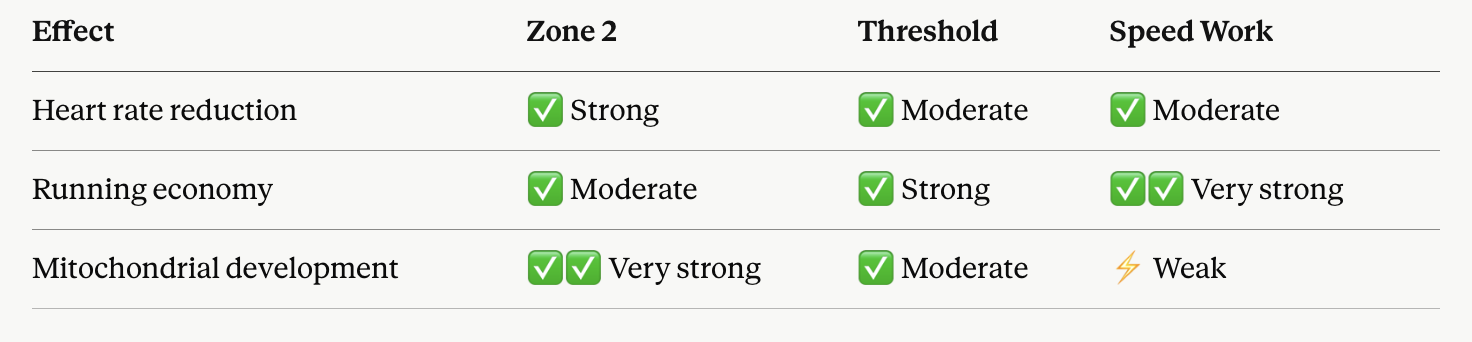
Research shows that running economy improves not from training in a single zone, but from a combination of different training types:
Easy running (zones 1–2) does improve economy — through mitochondrial adaptation, capillarization of muscles (the growth of a capillary network that increases blood supply to muscle tissue), and improved fat metabolism (developing the ability to use fat as a primary energy source). However, these adaptations accumulate slowly and require high training volume.
Threshold training (zones 3–4) delivers faster gains in running economy by raising the lactate threshold — your ability to sustain a pace close to your anaerobic threshold for extended periods.
Speed work (zone 5) improves running mechanics, neuromuscular efficiency, and tendon stiffness. This is one of the most powerful stimuli for improving running economy and lowering heart rate at race pace.
Heart Rate Adaptation
A drop in heart rate at the same speed — the reverse of cardiac drift — is a sign of increased stroke volume: the amount of blood (in ml) the heart can pump with each beat. Zone 2 training is particularly effective here, as workouts at ~60–70% of maximum heart rate optimally stress this mechanism. But does this alone make you faster when you need to run fast? No — it's necessary, but not sufficient. Threshold and speed sessions are essential components.
For a closer look at what threshold and speed workouts look like in practice, see our next blog post.
The Bottom Line
Zone 2 is a necessary foundation — but not enough on its own to lower your heart rate at race pace or improve running economy. The popular idea of "zone 2 only" training oversimplifies the picture.
Elite training programs are built on the 80/20 principle: roughly 80% of volume in easy zones (1–2) and 20% at high intensity (zones 4–5). This combination delivers the greatest gains in both running economy and heart rate reduction.
This golden ratio is built into the training plans of the OMY! Sports app.
Your OMY! Sports Team
References
- Stöggl, T., & Sperlich, B. (2014). Polarized training has greater impact on key endurance variables than threshold, high intensity, or high volume training. Frontiers in Physiology, 5, 33. https://doi.org/10.3389/fphys.2014.00033
- Cerezuela-Espejo, V. et al. (2025). Effects of 20 Weeks of Endurance and Strength Training on Running Economy, Maximal Aerobic Speed, and Gait Kinematics in Trained Runners. Applied Sciences, 15(2), 903. https://doi.org/10.3390/app15020903
- Festa, L. et al. (2019). Effects of Different Training Intensity Distribution in Recreational Runners. Frontiers in Sports and Active Living, 1, 70. https://doi.org/10.3389/fspor.2019.00070
- Muñoz, I. et al. (2014). Does Polarized Training Improve Performance in Recreational Runners? International Journal of Sports Physiology and Performance, 9(2), 265–272.