In 2018, a group of scientists led by Caio Victor Souza of the Catholic University of Brasilia, along with representatives from Greece and Switzerland, predicted that the sub-2-hour marathon would be run in 2026. Based on an analysis of running results from 1999 to 2018, this runner was expected to be a 27-year-old East African (most likely Ethiopian) with a VO2 max >85 ml/kg/min.
Despite the faster improvement in marathon performance among women, physiological differences from men (lower VO2 max and muscle mass), and taking into account women's actual marathon results, it is not yet possible to predict that female marathoners will break the 2-hour barrier. However, the scientists believe that "it is absolutely possible" in the future.
Despite the faster improvement in marathon performance among women, physiological differences from men (lower VO2 max and muscle mass), and taking into account women's actual marathon results, it is not yet possible to predict that female marathoners will break the 2-hour barrier. However, the scientists believe that "it is absolutely possible" in the future.
Mathematics for Running
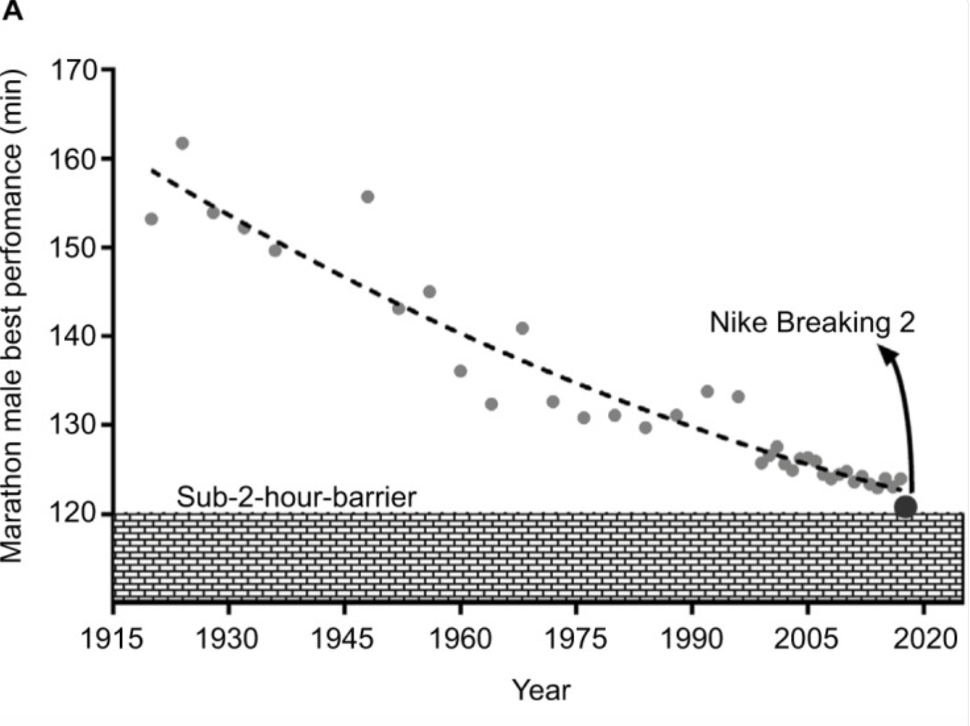
The forecast was based on mathematical methods of regression analysis, which resulted in a quadratic equation describing this regression with a 94.1% confidence interval:
y = 0.0417x2 – 14.18x + 3128
Graph A shows the distribution of men's marathon times and the regression line (in minutes) from 1915 to 2018. Graph B shows women's times. In both cases, outstanding male and female times at the time of analysis (2018) are highlighted.
y = 0.0417x2 – 14.18x + 3128
Graph A shows the distribution of men's marathon times and the regression line (in minutes) from 1915 to 2018. Graph B shows women's times. In both cases, outstanding male and female times at the time of analysis (2018) are highlighted.

What happened in reality
On April 26, 2026, 30-year-old Kenyan Sebastia Sawe ran the London Marathon in 1:59:30, while 28-year-old Ethiopian Yomif Kejelcha finished second with a time of 1:59:41. By scientific standards, this forecast result can be considered perfectly accurate.
Critical Factors for Marathon Performance
What physiological demands are placed on an athlete aiming for such a result? Which ones are more important than others? And how can this apply to training for recreational runners striving to improve their marathon performance, regardless of skill level?
The following parameters are crucial for marathon performance: VO2 max, anaerobic metabolic or lactate threshold (LT), and running economy.
For a championship result, a VO2 max of 70 to 85 ml/kg/min is required. Furthermore, a record-breaking runner must be able to maintain a running intensity equivalent to 75-85% of VO2 max throughout the entire marathon distance. VO2 max is important, but as further discussion will show, it is not the most important factor.x
The following parameters are crucial for marathon performance: VO2 max, anaerobic metabolic or lactate threshold (LT), and running economy.
For a championship result, a VO2 max of 70 to 85 ml/kg/min is required. Furthermore, a record-breaking runner must be able to maintain a running intensity equivalent to 75-85% of VO2 max throughout the entire marathon distance. VO2 max is important, but as further discussion will show, it is not the most important factor.x
VO2 max or running economy?
The most important factor is running economy. In other words, the pace a runner can maintain at a given intensity (85% of VO2 max). The faster the pace at the same intensity, the higher the running economy. In other words, economy measures how fast a runner can run without extra effort (85% of VO2 max is still not considered extra effort).
For example, elite Spanish marathon runners often have VO2 max equal to African runners, but African runners have better economy and, as a result, higher results. Much higher.
Running economy (RE) is the most trainable metric, meaning it's the one most susceptible to improvement through training. This isn't true, for example, of VO2 max, which is virtually impossible to improve—meaning it's largely predetermined at birth. Trainable improvements in running economy enable faster running speeds at submaximal intensities and also delay the onset of the LT , which is critical for the marathon distance. Recall that ATOM is the intensity level at which lactate production in the body occurs faster than it is metabolized, leading to a slower running pace. Together, EB and LT have a greater impact on performance than VO2 max alone, taking into account possible improvements in performance.
For example, elite Spanish marathon runners often have VO2 max equal to African runners, but African runners have better economy and, as a result, higher results. Much higher.
Running economy (RE) is the most trainable metric, meaning it's the one most susceptible to improvement through training. This isn't true, for example, of VO2 max, which is virtually impossible to improve—meaning it's largely predetermined at birth. Trainable improvements in running economy enable faster running speeds at submaximal intensities and also delay the onset of the LT , which is critical for the marathon distance. Recall that ATOM is the intensity level at which lactate production in the body occurs faster than it is metabolized, leading to a slower running pace. Together, EB and LT have a greater impact on performance than VO2 max alone, taking into account possible improvements in performance.
How is running economy trained?
What improves running economy most? These are primarily strength training, developing strength endurance (hill running), and speed training (interval or progressive running). For example, a 10-week strength training block doesn't increase VO2 max, but it improves running economy by 4%, which improves marathon performance. How does this work? It simply reduces the energy cost of running, thereby improving performance. Running at or slightly above the lactate threshold (LT) (usually intervals from 600 to 1500 meters) also improves running economy.
Analysis of physiological factors showed that VO2 max accounts for 25% of performance, LT accounts for 35%, and running economy accounts for 40%. The same distribution applies to recreational runners, regardless of performance.
Analysis of physiological factors showed that VO2 max accounts for 25% of performance, LT accounts for 35%, and running economy accounts for 40%. The same distribution applies to recreational runners, regardless of performance.
Genetics
Genetic factors were also taken into account. East African runners are the clear favorites in genetics, with an overwhelming 85% share. Eastern European runners are second in genetic predisposition for high marathon results (14%), while representatives of other genetic populations account for about 1% of the probability of achieving high results. Incidentally, we could argue with this – consider the Japanese, for example.

Competition Factor
The final important factor in high results is competition, or the desire to beat a very strong opponent. In the case of the London Marathon, it's important to note that all three winners ran faster than the previous marathon record: Save - 1:59:30 (1st), Kejelcha - 1:59:41 (2nd), and Kiplimo - 2:00:28 (3rd). Competition, mutually beneficial drafting, and the finishing battle between such strong and record-setting competitors are the strongest factors. Save might not have set this record without Kejelch and Kiplimo. He simply turned out to be the strongest of them.
What's in this for amateurs?
For the vast majority of running enthusiasts, a two-hour marathon is out of reach. But there are many important conclusions that can be drawn from everything written above, especially regarding how to put all the pieces of the puzzle together that constitute a strong personal best in a marathon.
Marathon for amateurs isn't about winning, it's about overcoming oneself and the difficulties that each marathoner will face alone over the course of 42 km 195 meters. The success of these efforts depends on everything we represent when we step into the starting line: ourselves (plus our running shoes), our training, our emotions, energy, and experience.
Of course, the conditions in which amateurs train differ from those of elite runners. But the training methods and principles of individual preparation are very close to those of the professional level. They include elements for developing running economy, LT training, and VO2 max segments. Therefore, sooner or later, depending on each individual's abilities, results will come. The main thing is to give yourself time and follow the plan.
Marathon for amateurs isn't about winning, it's about overcoming oneself and the difficulties that each marathoner will face alone over the course of 42 km 195 meters. The success of these efforts depends on everything we represent when we step into the starting line: ourselves (plus our running shoes), our training, our emotions, energy, and experience.
Of course, the conditions in which amateurs train differ from those of elite runners. But the training methods and principles of individual preparation are very close to those of the professional level. They include elements for developing running economy, LT training, and VO2 max segments. Therefore, sooner or later, depending on each individual's abilities, results will come. The main thing is to give yourself time and follow the plan.
We wish you excellent training, progress in your results, and the courage to overcome your own challenges.
Your OMY! Sports team