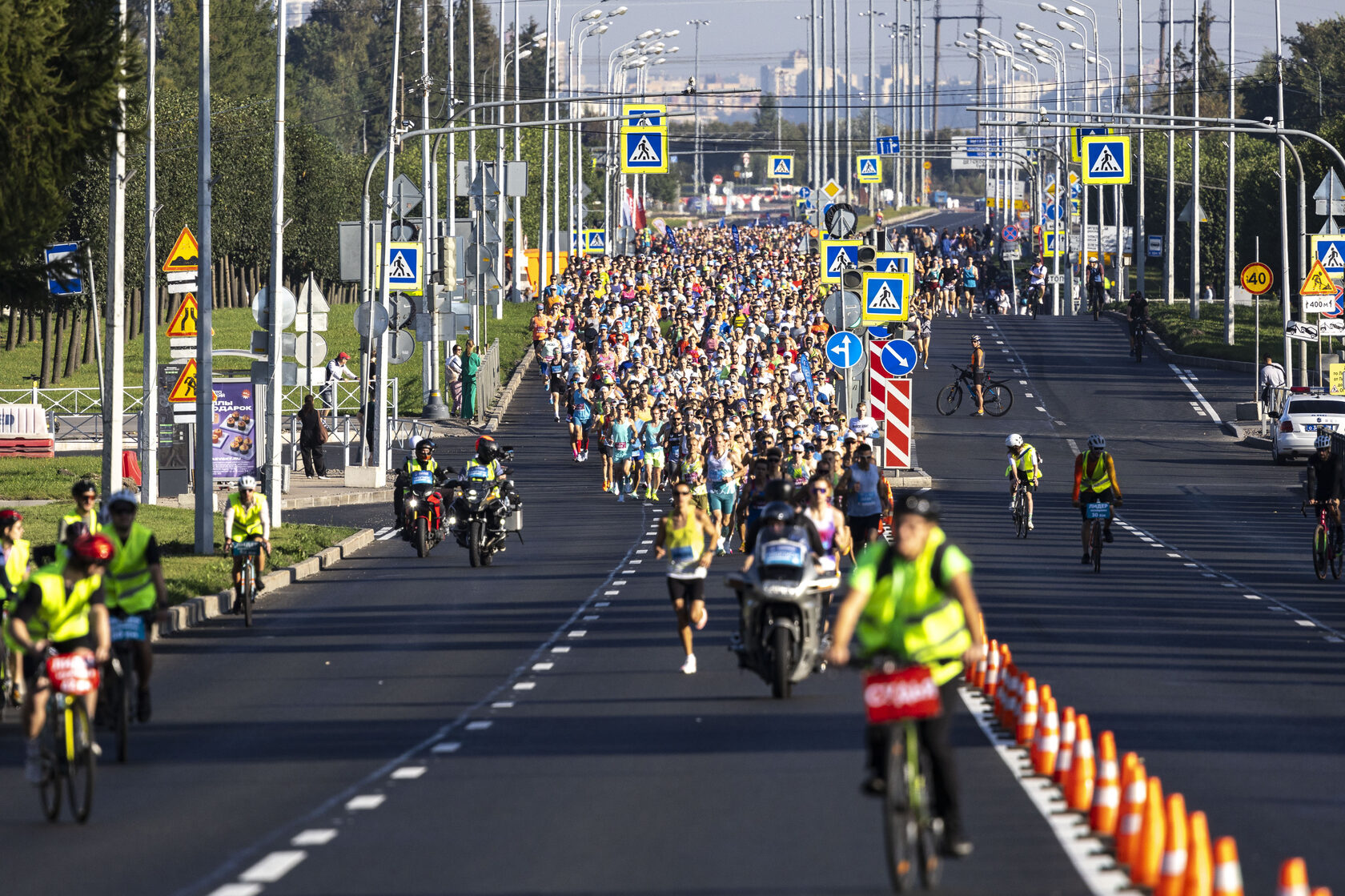
There are races that define an era and there is one race that has outlasted several of them.
On September 6, 2026, the Pushkin — St. Petersburg Marathon will be held for the 99th time. Not a relaunch, not a reimagined format: just ninety-nine consecutive years of the same race, on the same route, in the same city. London Marathon launched in 1981. Berlin in 1974. Boston — the oldest of the World Marathon Majors — started in 1897. Pushkin — St. Petersburg: 1923. Since then it never stopped.
What the Majors give you — and what they don't
The World Marathon Majors are extraordinary events. Berlin is where world records go to die — or rather, to be reborn. London turns the entire city into a stadium. Tokyo is a masterclass in organization. These races are bucket-list experiences, and rightly so.
But they are also, increasingly, logistical puzzles: entry by lottery, waiting lists measured in years, fields of 40,000 to 50,000 runners. Corrals, waves, crowds so dense that the first few kilometers feel more like rush hour than a race.
Pushkin — St. Petersburg is not that. And for a growing number of serious amateur runners, that is exactly the point.
The route London and Berlin can't replicate
The race starts in Pushkin — the former Tsarskoye Selo, the imperial residence where Catherine the Great built her palace and where Alexander Pushkin spent his school years. The course then runs 42 kilometers in an almost perfect straight line down Moskovsky Prospekt — one of St. Petersburg's great boulevards — and finishes on Palace Square, in front of the Winter Palace and the Hermitage.
From an imperial summer residence to the heart of the Russian Empire's capital. In one run.
Berlin's course is flat and fast through a reunified city. London's route is iconic, winding past Tower Bridge and Buckingham Palace. Pushkin — St. Petersburg is linear, ceremonial, and carries a weight of history that neither can match. The course is AIMS-certified and considered the fastest in Russia — the kind of flat, straight, September-cool track that invites personal bests.
The race that survived everything
London 2026 will go down in history as the race where Sabastian Sawe became the first man to officially break two hours. A landmark moment in a landmark city.
Pushkin — St. Petersburg has its own kind of landmarks — quieter, but no less real. It ran through the Soviet era. From civil war and WW2, through the nineties, through everything the city formerly known as Leningrad endured. While other races were being founded, relaunched, rebranded, or cancelled, this one simply kept going.
That continuity is not a small thing. It is, in many ways, the whole story.
A different kind of race experience
The Majors have become cultural events as much as athletic ones. Hundreds of thousands of spectators. Live bands every kilometer. Corporate sponsors visible from space. The racing is almost incidental to the spectacle.
Pushkin — St. Petersburg hasn't gone that route. The field is smaller, the atmosphere quieter, the focus sharper. The people who travel to run this race tend to know why they're there. It draws runners who want to race — not perform, post or celebrate finishing — but actually race, on a course that rewards them for it.
September in St. Petersburg helps. Temperatures between 10 and 15 degrees at the start, clear skies, golden leaves along the boulevard. The kind of morning that makes 42 kilometers feel — briefly, deceptively — manageable.
How to train for a race that deserves your best
The course is forgiving — flat, fast, cool. But a marathon is still a marathon, and showing up undertrained on one of the world's oldest routes isn't the way to honor either the distance or the occasion.
There is still enough time before September 6, 2027 to build a proper plan. Not so long that you burn out before the start line. Not so short that you arrive underprepared. The things that will define your result are straightforward: dynamic weekly volume, tempo runs above anaerobic threshold, and a smart taper in the final two to three weeks.
This is exactly where OMY! Sports can help. You'll get an individual training plan built around your current fitness and your specific goal — not a generic template, but a program that accounts for where you are right now and what you're trying to achieve. Our coaching team and Rob, our AI coach, will analyze each completed workout, answer your questions, and keep you on track all the way to Palace Square.
Ninety-nine years of history deserve your best race.
The 100th edition is coming
Next year, this race turns 100. Berlin will reach that milestone in 2074. London won't get there until 2081. Pushkin — St. Petersburg will be there next year.
If you've run a Major and want to understand what the sport looked like before it became an industry — or if you simply want to run one of the world's oldest marathons on one of its most extraordinary routes — a day in September, 2027 is your chance to be part of the 100th edition. And it will be historic.