The race in Hawaii can't be compared to other endurance events: marathons, ski races or cycling races. Here athletes compete not so much on muscular power or aerobic capacity, and speed is not what decides the result. The key to success is how the brain adapts to physical suffering, and the balance between the body's absolute limits and the ability to ignore pain. Fail to find that balance and you collapse: the body shuts down even though the mind still wants to keep going.
The outliers
That is why Kona doesn't read CVs. An Olympic pedigree guarantees nothing here. Kona's elite is full of people who were never products of a sporting system, on the contrary - often was rejected by it. Denmark's Magnus Ditlev is a chemical engineer who came to triathlon with no background in any of its three disciplines. America's Matthew Marquardt is a medical student and aspiring cancer surgeon who discovered triathlon in his first year of med school. Britain's Kat Matthews is an army physiotherapist who started with a military triathlon camp in Cyprus, mostly as a way to escape work for two weeks. The ability to look beyond your own limits, it seems, is not something federations can teach. Either it's inside you or it isn't.
The island reminds everyone of this every year. In 2026, it did so nine times.
Nine dramas of Kona 2026
Drama No. 1. A Last Dance cut short. One of the favourites, Germany's Patrick Lange, had announced in advance that this would be his last dance at the Ironman World Championship. He made it only halfway through the bike: with cramping legs, he pulled out at the Hawi turnaround.
Drama No. 2. Same place, same ending. Britain's Lucy Charles-Barclay built her entire season around this race, skipping many others, determined to do better than last time, when she dropped out on the run near the Energy Lab. This time she was first out of the water, yet her race ended in the same place, while she was running in third. She was violently sick before she could walk off the course on her own.
Drama No. 3. The leader who stopped. Magnus Ditlev posted the fastest bike split (4:06:47), led into T2 and stayed in front until 30 km into the marathon. Then he slowed to a walk and dropped out with just over 10 km to go, handing the lead to France's Vincent Luis.
Drama No. 4. The longest kilometre. The women's leader and defending world champion, Norway's Solveig Løvseth, reached kilometre 41 of the marathon. There, one kilometre from the finish, roughly four minutes from the finishing arch, she collapsed from exhaustion, seemingly almost knocked out. She got up, took a few more steps and sat down again. She did make it to the finish, but only in eighth place, in 9:02:08, to a standing ovation. One small consolation: by finishing, Solveig held on to second place in the Ironman Pro Series standings and its $130,000 bonus.
Drama No. 5. The undefeated. France's Sam Laidlow arrived in Hawaii having won all four of his races that season, including a world-record Challenge Roth. Five kilometres into the run he stopped: his left leg had suddenly gone numb below the knee. The cause turned out to be vascular, not muscular. Sam has iliac artery endofibrosis: endless hip flexion on the bike thickens the artery wall and reduces blood flow to the leg. He now faces surgery.
Drama No. 6. An Olympic champion in the Energy Lab. Clear favourite Kristian Blummenfelt fell away from Vincent Luis around the Energy Lab. The Norwegian wilted in the Hawaiian humidity, ran a 2:49 marathon and finished only eighth, 10:39 behind the winner. In the process he let Matthew Marquardt back into the race after seemingly dropping him. The medical student ended up on the podium in third.
Drama No. 7 (a happy one). A chance not to be missed. America's Taylor Knibb was throwing up on the run and had given up hope of winning. But Løvseth's collapse one kilometre from the line handed her an opening, and Taylor took it. She won in 8:36:29, becoming the first American women's world champion since 2022. She is also only the third woman in history to win both the full-distance title and the 70.3 World Championship in the same year; she took the latter in Nice a month earlier. Second place went to Germany's Laura Philipp, who started the marathon in tenth, nearly ten minutes off the lead, then ran the fastest women's marathon of the day (2:50:42) and clinched the Pro Series title along the way. Fourth, with the second-fastest women's marathon, was army physiotherapist Kat Matthews.
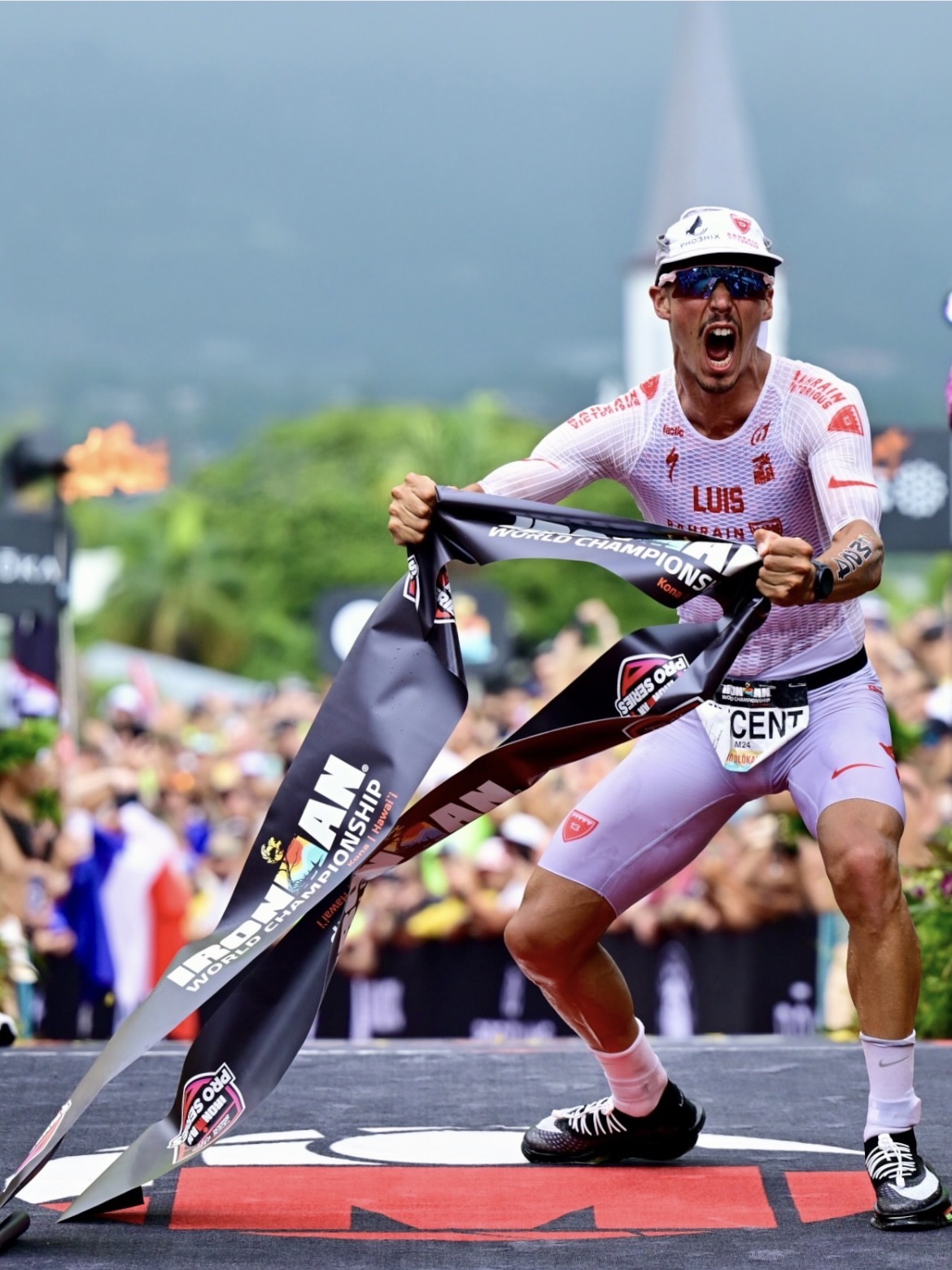
Drama No. 8 (a happy one). Not needed by his federation. France's Vincent Luis is a two-time world champion and three-time Olympian. In 2024 he was left out of the team for the home Games in Paris, and wrote at the time: "It seems that my Federation doesn't need me anymore." Before Kona he announced that he would retire from professional triathlon after this race, making it his first and last Ironman World Championship. Then he went and won it in 7:47:27, becoming the first Frenchman to win in Kona.
Drama No. 9. Three minutes. Norway's Gustav Iden received a three-minute drafting penalty on the bike. He had to serve it at the start of the marathon, leaving T2 almost nine minutes behind the leaders. What followed was a brilliant race: he ran the fastest marathon of the day (2:36:57) and finished second, just 1:35 behind Luis. Without the penalty, he would most likely have been world champion. Gustav dedicated this race to a cancer research foundation; his mother died of cancer three years ago. He has a consolation too: Iden won the Ironman Pro Series and its $200,000 bonus.
The energy of the rejected
"The island will always win," Taylor Knibb said after the finish. The Energy Lab is the stretch of road where the strongest break. But Kona has another kind of energy, too: the energy of the rejected. It is carried by those the system never selected, passed over or wrote off: an engineer who started from zero, a medical student, an army physiotherapist, a Frenchman whose federation made it clear it no longer needed him. Kona doesn't read résumés. It only tests how much you can endure and how precisely you know your own worth. This year, the person who knew it best was the man who had once been told "no."